
Choosing a Comprehensive Practice Management Solution for Behavioral Health
Introduction
Behavioral health practices rarely struggle because they lack tools. They struggle because too many important functions live in different tools that were never designed to work together. Scheduling, intake, documentation, billing, reminders, assessments, and patient messaging often operate as separate systems, each asking clinicians and staff to manually bridge the gaps.
Choosing a practice management solution is therefore not just a software purchase. It is a decision about how much friction the practice will continue to carry every day. The right platform should reduce administrative drag while making the clinical workflow easier to see and manage.
For behavioral health specifically, “comprehensive” has to mean more than calendar plus invoicing. It should include the operational basics, but it should also support continuity of care, outcomes tracking, and the ability to respond to patient needs without creating another layer of manual work.

What Comprehensive Should Mean
A comprehensive solution should act as a central operating system for the practice rather than a single-purpose add-on. That means it should connect the administrative side of care with the clinical side of care.
In practical terms, the platform should unify:
- scheduling and cancellations
- intake and forms
- billing and invoicing
- secure patient communication
- documentation workflows
- assessments or progress tracking
If those functions still require repeated exports, duplicate entry, or staff workarounds, the platform may be useful, but it is not truly comprehensive.
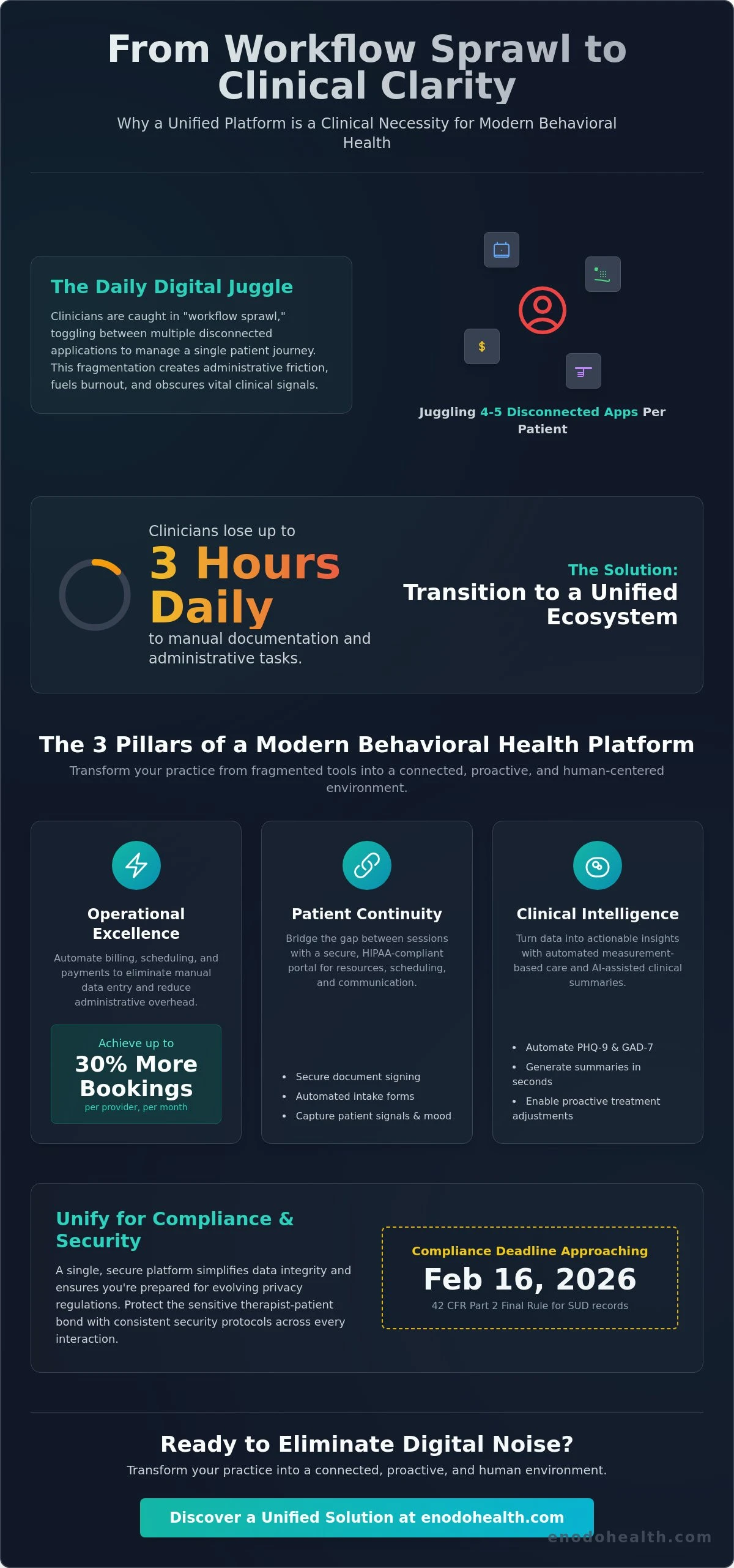
Three Pillars to Evaluate
Operational reliability
The first pillar is operational reliability. A practice needs software that makes day-to-day coordination predictable. Automated reminders, self-scheduling, waitlist management, invoicing, and reporting all matter because they reduce the constant background work that drains time from the team.
This is the layer that determines whether the practice feels manageable or chaotic. Even strong clinical work becomes harder to sustain when the operational base is unstable.
Patient continuity
The second pillar is patient continuity. Therapy does not begin and end with the scheduled appointment. Patients need a secure way to receive forms, complete check-ins, review next steps, and stay connected to their care between sessions.
When this layer is missing, the practice loses visibility between visits and patients experience care as a series of disconnected touchpoints. A stronger platform supports continuity without making every follow-up task manual.
Clinical visibility
The third pillar is clinical visibility. Behavioral health practices need more than storage for notes. They need a system that helps clinicians recognize progress, stalled treatment, repeated symptoms, and risk signals over time.
That may include structured documentation, measurement-based care workflows, and a clearer connection between assessments, session summaries, and treatment planning.
Why Fragmented Tools Cost More Than They Seem
Practices often accept fragmented tools because each product solves one local problem. A separate scheduler seems manageable. A separate billing platform seems fine. A separate portal or form tool looks harmless. The cost appears small until the staff has to keep reconciling everything.
The hidden costs include:
- repeated manual entry across systems
- more room for inconsistent records
- slower onboarding and staff training
- weaker visibility into patient progress
- more after-hours cleanup for clinicians and administrators
A fragmented stack can look inexpensive at the product level while remaining expensive at the workflow level.
How AI and Automation Fit In
Automation is useful when it removes repetition without removing judgment. For practice management, that means using technology to handle reminders, routine intake steps, billing workflows, documentation scaffolding, and outcomes delivery in a way that still leaves clinical decisions with the therapist.
AI can be helpful inside this environment when it supports documentation, summarizes patterns, or makes connected information easier to interpret. But it should be evaluated as part of the system, not as a standalone novelty. A good AI feature inside a fragmented workflow still leaves the practice fragmented.
Questions Worth Asking Before You Choose
When comparing platforms, the most useful questions are about the workflow around the feature set.
- Does information move cleanly from intake to session to billing?
- Can the clinician see relevant patient context without searching across tools?
- Are assessments and progress signals connected to the chart?
- Does the platform reduce staff coordination overhead?
- Will this help the practice scale without adding more administrative labor?
These questions usually reveal the difference between software that is feature-rich and software that is genuinely practice-ready.
What Good Adoption Looks Like
A good implementation should simplify the first month of use, not complicate it. Data migration, staff onboarding, template setup, and patient communication all need to be part of the transition plan. The best system on paper will still fail if adoption creates confusion or interrupts active care.
For that reason, the platform should make the first wins visible quickly:
- fewer manual reminders
- faster intake completion
- cleaner invoicing
- easier note completion
- better visibility into upcoming sessions and patient follow-up
Early clarity matters because it builds trust that the new system is reducing burden rather than shifting it somewhere else.
Conclusion
Choosing a comprehensive practice management solution for behavioral health means choosing how connected the practice will be. A strong platform does not just digitize existing chaos. It reduces it by bringing operations, patient continuity, and clinical visibility into the same workflow.
That is the real standard. The right system should help the practice spend less energy coordinating software and more energy supporting patient care.