
AI Clinical Documentation for Therapists: Ending Workflow Sprawl
Introduction
For many therapists, the session is not the end of the work. It is the beginning of a second shift: reconstructing the conversation from memory, moving between note templates, checking prior records, updating treatment plans, and making sure billing and documentation still line up. That administrative chain is where momentum often breaks down.
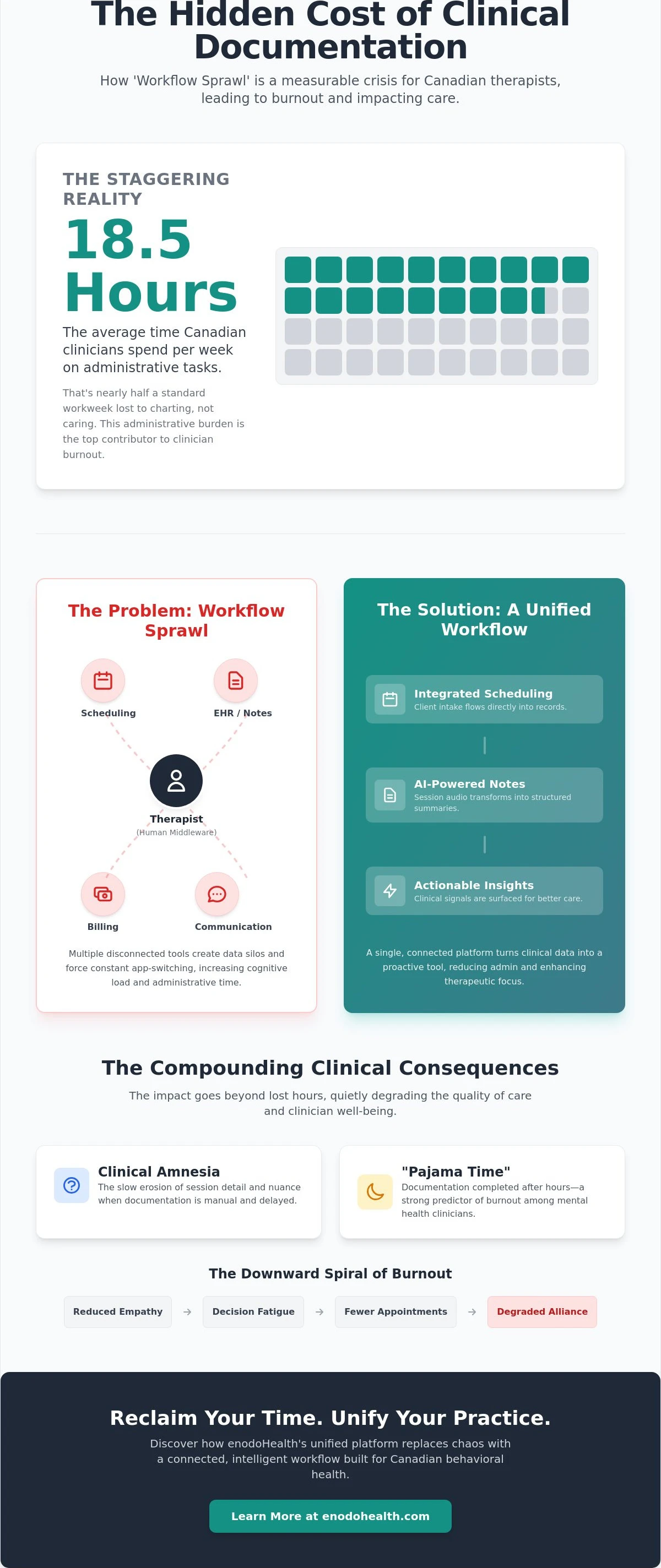
The problem is not only that documentation takes time. It is that documentation frequently happens inside a fragmented workflow. Scheduling, charting, patient communication, assessments, and billing often live in separate tools, so the therapist becomes the person stitching everything together. That is what workflow sprawl looks like in practice.
AI clinical documentation has become more useful because it can address both speed and structure. The better tools are no longer just trying to transcribe a conversation. They are trying to help therapists preserve nuance, reduce recall burden, and carry forward the clinical signals that matter for the next session.

What Workflow Sprawl Looks Like
Workflow sprawl happens when one clinical task depends on multiple disconnected systems. A therapist may finish a session, glance at handwritten notes, open a separate EHR, check a different calendar, confirm an invoice elsewhere, and then try to remember whether a homework pattern or risk concern should be reflected in the treatment plan. Each extra handoff adds friction.
That friction has direct consequences:
- Notes are delayed until details have already faded.
- Therapists spend more time re-entering information than interpreting it.
- Important patterns stay locked inside individual notes rather than building a longitudinal view.
- Administrative fatigue competes with the energy needed for the next patient.
This is one reason documentation feels heavier than its word count suggests. It is not just writing. It is context switching.
What AI Clinical Documentation Actually Does
At its best, AI documentation helps therapists move from recall-based charting to supported synthesis. Instead of staring at a blank note and rebuilding the session from fragments, the clinician starts with a structured draft that organizes the conversation into a usable clinical summary.
A well-designed workflow usually includes three steps:
- Session information is captured through audio, dictated notes, or structured inputs.
- The system organizes that material into a draft summary with major themes, interventions, and follow-up items.
- The therapist reviews, edits, and approves the final note before it becomes part of the chart.
That final review step is the difference between responsible assistance and automation that overreaches. The AI can help assemble the record, but the therapist remains accountable for what it means.
Why Nuance Still Matters
Therapy documentation is not only a list of topics discussed. It often needs to reflect ambiguity, resistance, emotional shifts, and emerging patterns that are easy to flatten into generic language. A client may sound stable while describing avoidance. Another may present as articulate and reflective while quietly deteriorating between sessions. Notes that miss that nuance can create a false sense of clarity.
This is why generic transcription is not enough for behavioral health. A useful documentation tool has to support clinical thinking rather than simply reproducing speech. It should help the therapist notice what belongs in the note, what belongs in the formulation, and what needs follow-up next time.
From Documentation to Clinical Visibility
The deeper value of AI documentation is not only time savings. It is continuity. When notes are structured consistently and connected to the rest of the workflow, they can become easier to search, compare, and use across sessions.
That changes the role of documentation:
- A note is no longer only a record of what happened.
- It becomes a bridge into the next session.
- It can surface recurring symptoms, language patterns, and treatment themes over time.
- It supports measurement-based care when assessments and session summaries live in the same system.
When that happens, documentation starts to support clinical visibility instead of merely satisfying compliance requirements.
What Responsible AI Requires
Therapists are right to be cautious. Documentation in behavioral health carries ethical, legal, and relational weight. A useful platform has to make that caution easier to uphold, not harder.
Responsible AI documentation should be:
- Human reviewed, so no note becomes final without clinician approval.
- Privacy conscious, with secure storage, controlled access, and clear data handling practices.
- Behavioral health aware, so the language and structure reflect therapy rather than generic medical shorthand.
- Integrated, so documentation is not isolated from scheduling, assessments, and patient engagement.
The standard should not be whether AI can generate text. The standard should be whether it helps a therapist document more clearly without weakening judgment or patient trust.
What Therapists Should Look For
When evaluating documentation tools, the most important question is not “Can this write notes?” It is “Does this reduce workflow sprawl in a meaningful way?”
Useful signals include:
- The note draft is editable and clinically structured.
- Session summaries connect to treatment planning or outcomes tracking.
- Documentation does not require manual transfer into other systems.
- The workflow reduces after-hours charting instead of simply moving it around.
- The platform supports practice operations and clinical continuity together.
If those pieces are missing, the software may save a few minutes on note generation while leaving the larger workflow problem untouched.
Conclusion
AI clinical documentation is most valuable when it solves the real problem therapists face: not just writing notes, but carrying too much disconnected administrative work around each note. The issue is workflow sprawl, and documentation is one of the places where that sprawl becomes most visible.
Used responsibly, AI can reduce recall burden, preserve more of the session’s nuance, and help turn notes into a stronger source of continuity from one visit to the next. The goal is not to replace clinical judgment. The goal is to give it a better operating environment.